 English is taught to all year groups daily. We use Talk for Writing as a key driver to deliver high quality English sessions. In addition, reading skills are taught in discrete lessons in all year groups.
Phonics is taught daily in Early Years and Key Stage one. We use the DFE approved scheme Twinkl Phonics to deliver high quality consistent phonic lessons. Twinkl Phonics is also used throughout KS2 as an intervention to address gaps in knowledge.
Understanding how language works enables learners to engage with the world around them and have greater control over their own communication and interactions. At Hodnet, we aim to equip our learners with the skills required to use English confidently throughout their school journey, as well as into their lives beyond.
Our curriculum, delivered by skilled teachers, allows children to become enthusiastic writers and motivates them to achieve their true potential in all aspects of school life. Through being taught how to command language properly, our pupils can learn to communicate their emotions effectively, and develop themselves culturally and socially.
At Hodnet we want our pupils to learn how to aim high, love literature, and be fully equipped with life-long transferable skills.
English Lead at Hodnet School is Mrs Bessant (Class 1 Teacher)
Praise indeed for Hodnet Primary Schools’ Phonics and Early Reading teaching.
Hodnet named in top 1% of schools in January 2024
Damian Hinds, MP, Minister for Schools, acknowledges our commitment and success in Phonics and Early Reading.
In 2024, we were recognised as being in the top 1% of all schools nationally having achieved 100% pass rate in the Year 1 phonics screening check. This was an excellent achievement and we feel very proud to have received this recognition. We were also praised by senior leaders at Shropshire Council and at The 3-18 Education Trust for this achievement.
Phonics Curriculum intent
At Hodnet Primary School we are passionate about ensuring that all of our children become confident and enthusiastic readers and writers with a love for books by the end of Key Stage One. We believe that phonics provides the foundations of learning to become fluent readers and writers. Through daily, systematic and consistent high quality phonics teaching, children learn to segment words to support their spelling ability and blend sounds to read words. To allow our children to develop a strong phonic awareness and effective blending and decoding skills, we have chosen to use the synthetic phonics programme ‘Twinkl Phonics’. A consistent and structured approach from Early Years, through Key Stage 1 and into Key Stage 2 for those who require it supports children to progress and gain the skills necessary to achieve these aims.
We strongly believe that teaching children to read and write independently is one of the core purposes of a primary school, enabling them to access a broad and exciting curriculum and ensuring they flourish as learners throughout their time at our school. These fundamental skills not only hold the keys to the rest of the curriculum but also have a huge impact on children’s self-esteem and future life chances.
Twinkl Phonics and Rhino Readers website link – www.twinkl.co.uk/resources/twinkl-phonics
Reading curriculum intent
Reading skills are a crucial part of life, both in school and in the wider world. These skills assist learners to understand the wider curriculum, and develop their own communication skills. Reading enables children to access learning and provides them with the independence needed to seek and enquire.
Through reading, learners have the opportunity to immerse themselves in new cultures, concepts and worlds, diversifying their worldview. At Hodnet, we want our children to leave school fully equipped with the skills necessary to achieve their dreams, and reach for the stars. We encourage a love of reading – opening their imaginations and broadening their minds.
Reading enables children to access learning and to immerse themselves in new cultures, concepts and worlds. In addition to our phonics teaching, we know that children a need to be taught a range of skills in order to be successful readers. As such, we incorporate reading skills lessons as part of our reading curriculum, focussing on vocabulary, reading fluency and comprehension skills. Texts are chosen with the aim of challenging children to read with fluency and understanding and to generate discussion.
KS1 pupils have a weekly reading skills lesson in addition to their daily phonics teaching. High quality picture books are used to expose children to a wide variety texts and authors. Children are then taught to read model texts based upon the original book and complete a range of activities to develop their comprehension skills.
KS2 pupils take part in reading lessons across the week. Texts are chosen to cover a wide range of genres and authors. Children are taught to read extracts with fluency, with echo reading and choral reading at the core of this teaching. They then complete a range of activities to develop their comprehension skills.
Writing Curriculum
At Hodnet we use Talk for Writing, an engaging approach to the teaching of writing used from Reception through to Year 6. The key feature of this approach is that children internalise the language structures needed for writing through orally rehearsing and reciting a model text. This enables children to imitate the language they need for a particular topic orally, before reading and analysing it, and then writing their own version. Each unit of work follows the same cycle of teaching and is based on a fiction or non-fiction text type which has a core model text for the children to learn. Once children have learnt this model text, they are taught to write their own version (innovate the text) before they independently write the text type.
Website link – www.talk4writing.com
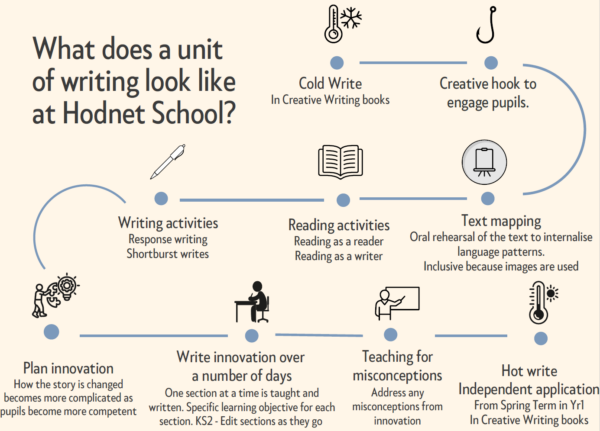
Handwriting
At Hodnet we recognise the important of handwriting as a foundational skill that children need to develop in order to become fluent writers. We use Letter Join as our handwriting scheme. Letter Join allows us to teach children the correct pencil grip needed for fluent writing. In Reception and KS1, children are taught to print letters, with a focus on the correct formation of each letter. At the end of Year 2 and into KS2, children learn to join their writing for increased fluency.
Website link – www.letterjoin.co.uk
Supporting Documents – Policies
English at Hodnet School 2025-27
Phonics and Early Reading at Hodnet School 2025-27
Supporting Documents – Writing
Talk for Writing Progression Document
English Vision Statement
Writing – Long Term Plan
Supporting Documents – Phonics
Phonics Vision Statement
Twinkl Phonics – Whole Scheme Overview
Progression in Phonics Reading Books
Supporting Documents – Reading
Reading Vision Statement
English Progression-of-Skills-and-Knowledge-Reading
Supporting Documents – Handwriting
Hodnet Handwriting Procedures – Letter Join
Letter formation rhymes